
Daoism
The indigenous Chinese religious tradition, including its history, texts, beliefs, and practices.
- Highest principle: Dao
- Knowledge: texts, deities, schools, ritual, and cultivation
- History: organized traditions emerged in the Eastern Han and continued to develop
DaoWiki Daoist Knowledge Base
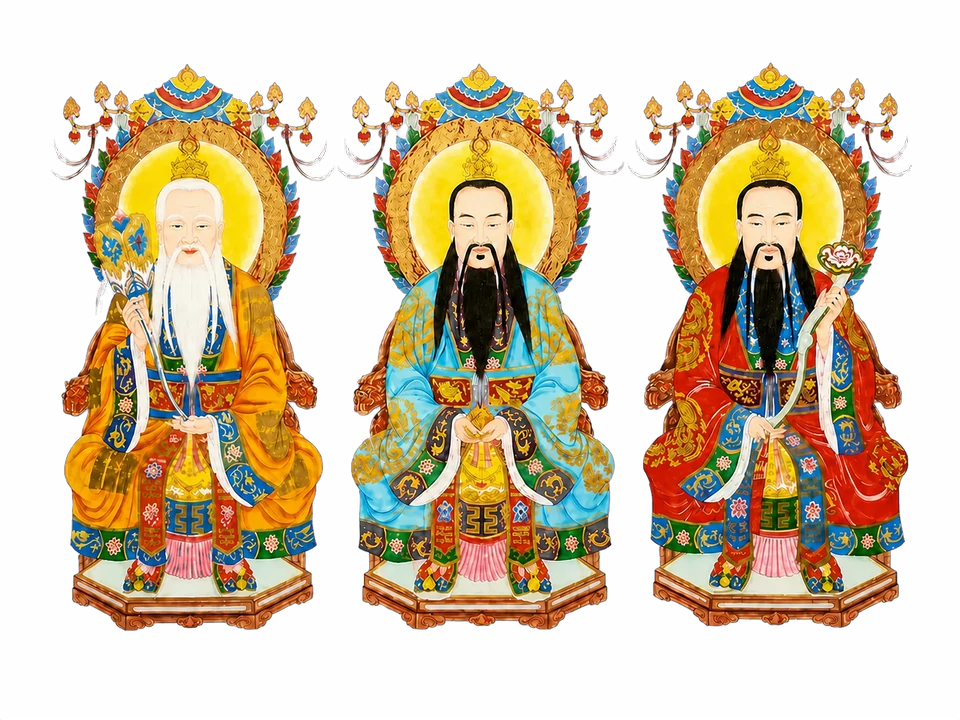
Three Pure Ones
The Three Pure Ones, the highest group of deities in the Daoist pantheon.
- Yuanshi Tianzun of the Jade Purity
- Lingbao Tianzun of the Highest Purity
- Daode Tianzun (Taishang Laojun) of the Great Purity
Selected knowledge entries
Structured guides completedTaking Refuge
Taking refuge in Daoism means turning toward the Three Treasures of Dao, scriptures, and teachers, establishing religious commitment and a path of learning. It may lead to further teacher relationships or cultivation, but does not automatically confer priestly status, register ordination, or monastic membership.
Revised 2026-09-11 →Traditions and LineagesReception of Registers
Shoulu, the reception of registers, is an important Daoist transmission, particularly in Zhengyi traditions. A teacher confers appropriate registers to establish lineage, rank, discipline, and ritual responsibilities. The register connects a recipient with teachings, divine offices, and religious obligations.
Revised 2026-09-11 →Traditions and LineagesChuan Du
Chuandu is a formal Daoist transmission through which a teacher receives a student into a line of training. It can establish teacher-disciple affiliation, a Daoist name or generational designation, precept obligations, and a course of study. In Zhengyi settings it may precede later reception of registers, but the sequence differs among traditions.
Revised 2026-09-27 →Deities and ImmortalsZhao Gongming
Zhao Gongming is revered in Daoism as Marshal Zhao of the Zhengyi Xuantan, or Mysterious Altar. His identities include a guardian marshal, a commander in thunder traditions, and a martial wealth deity. Zhao Xuantan, Marshal Zhao, and Black Tiger Xuantan usually refer to this same deity, while titles and divine retinues vary across traditions.
Revised 2026-09-11 →Deities and ImmortalsBeiji Quxie Yuan
The Northern Pole Exorcism Office is a celestial office and system of ritual ranks described in some Beidi and Fengdu Daoist texts. Titles including office commissioner, judge, departmental minister, and palace envoy express divisions of responsibility. It is a sacred institution within religious literature, not a real-world government office or the Beidi tradition as a whole.
Revised 2026-09-27 →Traditions and LineagesJingming Dao
Jingming Dao, also called the Jingming Zhongxiao tradition, formed around the cult of Xu Xun at Xishan near Nanchang during the Song and Yuan periods. It joins clarity of mind and loyalty-filial ethics with registers and liturgy. Sources differ on the roles of He Zhengong and Liu Yu in its foundation.
Revised 2026-09-27 →People and HistoryWei Huacun
Wei Huacun (about 252–334) was a woman associated with early Daoism in the Jin period. Later Shangqing sources call her Lady Wei of the Southern Sacred Peak and Zixu Yuanjun, placing her at the beginning of a scripture-transmission lineage. Biography and later revelation stories require different readings.
Revised 2026-09-27 →Cultivation and HealthShouyi
Shouyi, guarding the One, is a Daoist term for holding to unity, the genuine, or an inner One. Early texts offer ideas of embracing or keeping the One; later Daoist writings connect it with spirit, visualization, precepts, and cultivation. Depending on the scripture, the One may refer to the Dao, Taiyi, vital constituents, or inner deities.
Revised 2026-09-27 →Texts and LiteratureTaiping Jing
Taiping Jing is a major early Daoist scripture concerned with cosmic order, human conduct, and the ideal of great peace. The received text is composite and incomplete.
Revised 2026-09-27 →Rituals and CustomsJianzhai
Jianzhai is a title for an officer in some Daoist fasting rites. Historical manuals assign the officer oversight of liturgical order, restrictions, and mistakes, often alongside the gaogong and dujiang. Its actual duties depend on the manual and period.
Revised 2026-09-27 →Temples and GeographyMount Qingcheng
Mount Qingcheng, near the Chengdu Plain in Sichuan, is a Daoist sacred mountain closely associated with Celestial Master traditions. Its temples, caves, paths, and accounts of Zhang Ling form a religious landscape. Early narratives, inscriptions, and surviving buildings must be dated separately.
Revised 2026-09-27 →Culture and ArtsDaoist Dress
Guanfu is a collective term for headwear and clothing used by Daoist priests, including women priests. Daoist texts also distinguish ordinary dress from ritual vestments by rank, occasion, and scriptural tradition. No single dress code covers every period and community.
Revised 2026-09-27 →